Can Construction Dust Really Tank Your Solar Panel Output?
Yes — and it happens faster than most homeowners expect. If there’s new construction going on anywhere near your house, the dust it kicks up can settle on your solar panels and cut your power production enough that your monitoring app will actually flag it.
A real example: new-build dust and a power warning that wouldn’t go away
I’ve been on multiple jobs in newer neighborhoods where homeowners were getting warnings straight from their solar app telling them their power production was dramatically lower than normal. In every case, the cause was the same: dust from nearby construction settling on the panels. Once I got up there and cleaned them, the warning cleared out of their app and their power collection went right back to normal. That’s not a guess — that’s the homeowner watching their own numbers recover after the panels were clean.
Sometimes it’s not dust — it’s something touching the panel directly
Dust blowing in from a construction site is one thing, but I’ve also found more specific culprits. On one roof, I found a white, grimy film built up on a panel sitting right next to one of the cylindrical roof vents (the kind that vents plumbing or exhaust). That film was sitting directly on the glass, blocking light before it ever reached the cells underneath. Once I cleaned that panel off, output on it was restored. If a panel sits near a vent, a chimney, or anything else that can drift residue onto it, that spot deserves extra attention — it won’t always be obvious just glancing up from the ground.
Why this matters more in a place like Utah County
Utah’s dry climate is genuinely tougher on panels than most regions. Research on high-dust areas has found that panels left uncleaned can lose a real chunk of their output over time — dust simply doesn’t rinse off the way it might somewhere with regular rain. Between construction dust from fast-growing neighborhoods and our dry summers, panels here need more attention than the “clean it once a year” advice you’ll find written for wetter climates.
How I clean them
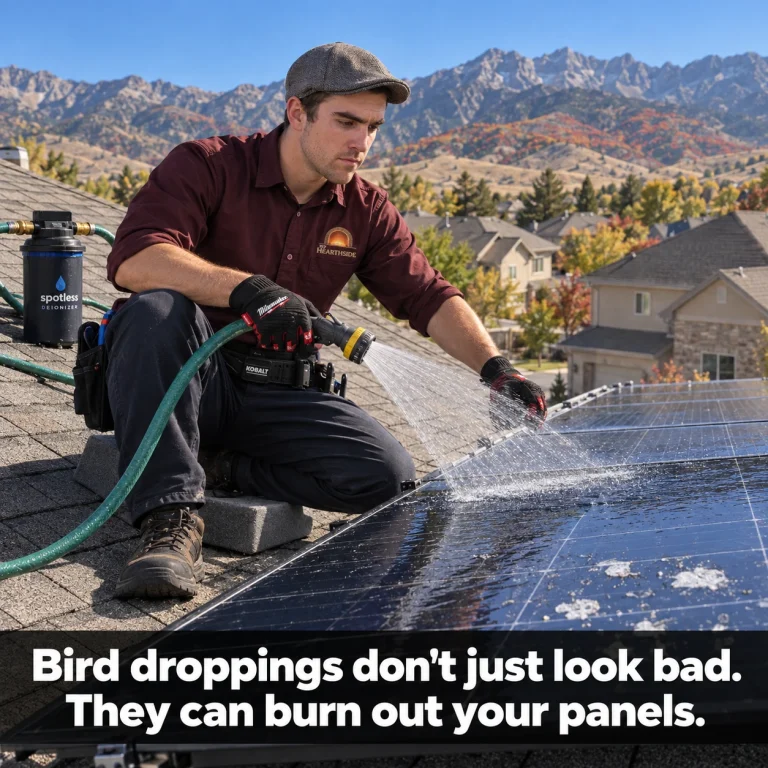
Every panel gets rinsed with deionized water — no squeegee, no scrub brush, nothing that touches the glass directly. The DI water strips minerals out before it ever reaches the panel, so it dries completely spot-free with no wiping and no residue left behind. That’s the only method I use on solar, every time.
If your solar app has been showing lower-than-expected production, or you know there’s construction going on nearby, it’s worth having your panels checked. Head over to Solar Panel Cleaning to see what to expect, or go straight to Contact & Quote and I’ll get you scheduled.